
Digitally Right, a Bangladesh-based initiative working at the intersection of technology and society and a partner of the Fojo Media Institute, has published a new study warning of serious safety risks for journalists ahead of the country’s 2026 elections. The organisation supports independent media, civil society and at-risk communities with the knowledge, tools and strategies needed to navigate an increasingly complex information ecosystem.
Journalists in Bangladesh continue to operate in a challenging and often dangerous environment, marked by political pressure, intimidation and rising digital threats. These risks are expected to intensify in the lead-up to the elections, compounding long-standing concerns around physical safety, harassment and surveillance, particularly for women journalists.
The study, “High Risks, Low Preparedness: Journalist Safety in 2026 Elections”, was conducted by Digitally Right as part of the Media Safety in the Digital Age initiative, in partnership with the Fojo and with support from the Swedish International Development Cooperation Agency (Sida). It draws on a survey of 201 journalists across 19 districts, as well as 10 in-depth interviews, to assess both the threats journalists face and the level of preparedness within newsrooms.
“We deliberately wanted to go beyond Dhaka and beyond senior leadership,” Miraj Chowdhury, Managing Director of Digitally Rights says. “We wanted to hear from journalists in remote and regional areas, and from women reporters, who are often underrepresented in this kind of research.”
The findings paint a stark picture:
89 per cent of journalists surveyed anticipate physical assault during the election period, while 76 per cent fear verbal harassment. More than 90 per cent identify political actors as the main perpetrators of violence. The study also reveals pronounced gendered risks, with 50 per cent of female journalists fearing sexual harassment and 80 per cent expressing concern over surveillance. At the same time, preparedness remains critically low, fewer than one in four journalists have received safety training or protective equipment, and 77 % report that their newsrooms lack digital safety protocols.
“In one sentence,” Chowdhury says, “this study shows that we are anticipating higher risks, but we are not prepared.”
The study also highlights widespread fears around surveillance, data seizure and disinformation—digital threats that can escalate into physical danger.
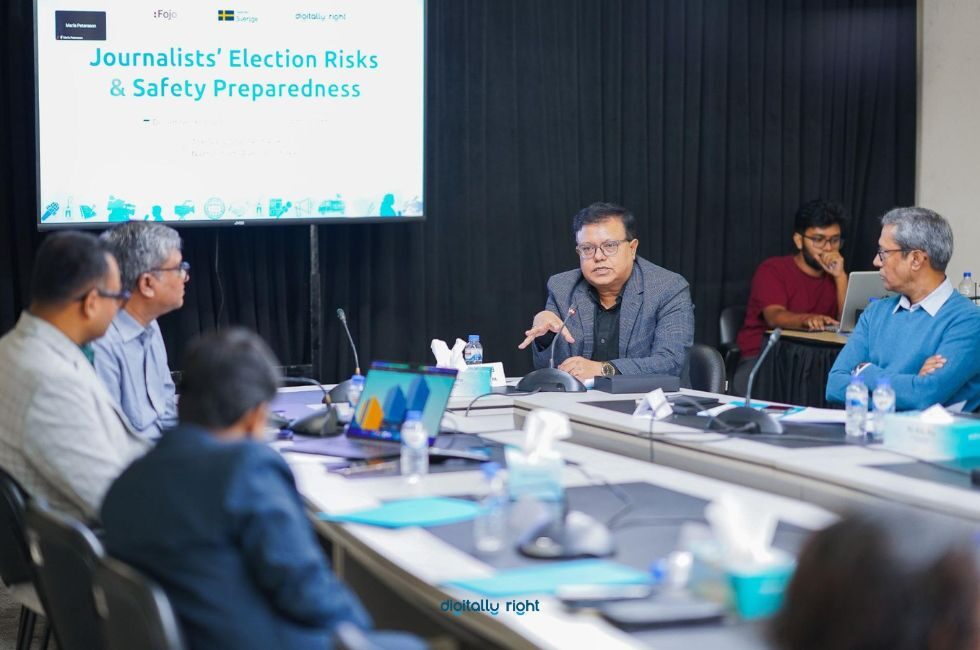
To discuss the findings, Digitally Right convened a roundtable on 6 December 2025 titled “Journalists’ Election Risks & Safety Preparedness” at The Daily Star Centre in Dhaka. Sixteen senior editors and newsroom managers participated, validating the research through their own experiences and highlighting the reluctance of media owners to invest in safety measures. Participants stressed the urgent need for internal guidelines and self-regulation in the absence of institutional support.
In response, Digitally Right has expressed its readiness to support newsrooms in developing safety policies and preparedness measures, should there be demand, closely aligned with Fojo’s ongoing work to strengthen media safety and resilience globally.
“Newsroom leaders are key stakeholders,” Chowdhury notes. “They have the ability to create systems to protect journalists and to push for an enabling environment beyond their own organisations.”
Media coverage: The study was featured in the Daily Star the day after it’s release.