


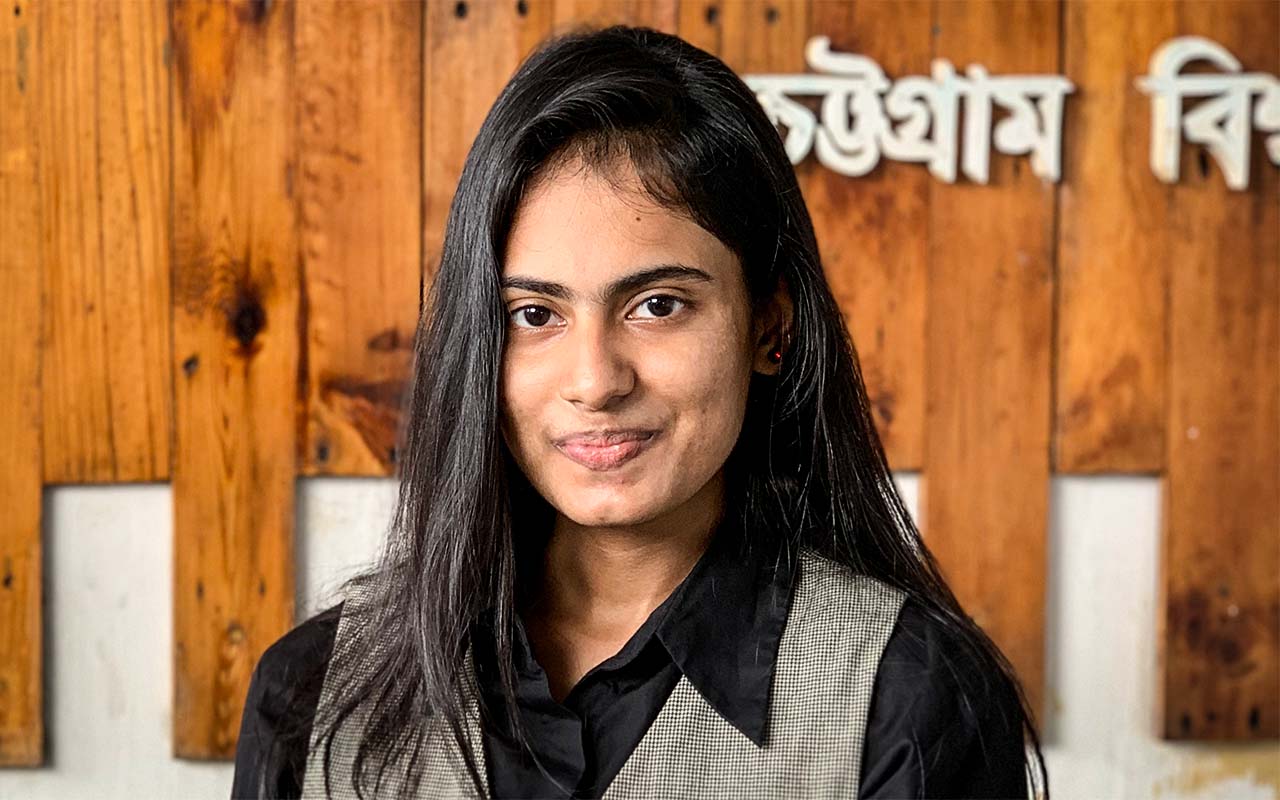
DHAKA. Entering Bangladesh’s male-dominated media industry as a young woman often means confronting deeply entrenched systemic barriers from day one. However, at a recent workshop delivered by Fojo Media Institute, transforming these hurdles from personal challenges into structural issues proved to be a powerful catalyst for change. “When you think of it as a structural problem and something we must work on, it becomes motivating,” noted one participating student.
For young women entering journalism in Bangladesh, marginalisation tends to come early and in many forms. Subha Tahsin, a 24 year-old communication and journalism student at Chittagong University in Bangladesh, had spent some time working behind the camera on field missions prior to her graduation and her experiences were no different.
“When you’re handling the camera, you don’t get space. I was often the only woman among male cameramen, and it was hard to push through both physically and socially. It made me feel like there was no future for me behind the camera.”
A male-dominated sector
Bangladesh’s media sector has grown quickly over the past two decades, but leadership has remained largely male. Field reporting environments are also largely male-dominated. Women make up around 20 – 25 percent of journalists in the country, and less than 10 percent hold editorial leadership roles, according to surveys by the International Federation of Journalists (IFJ) and UN Women.
Before the Women Media Leaders of Tomorrow (WMLT)-workshop held by Fojo Media Insitute in Dhaka, Bangladesh, Subha Tahsin, who has since then transitioned into the post-production sector and no longer works as a professional camera person, saw her experiences as personal weaknesses. During the workshop sessions, senior journalists offered a different perspective:
“When you think of it as a structural problem and something we must work on, it becomes motivating. When you think it’s a personal failure, it’s very discouraging and you feel isolated and alone.”
This shift, from self-doubt to understanding systemic inequality, was one of the workshop’s most important impacts, according to Subha. By sharing similar experiences, the facilitators helped younger journalists realise that these challenges are common problems and not individual shortcomings.
Participants also discussed broader concerns about working in Bangladesh’s media industry. Among them were low starting-salaries, job insecurity and harassment. More than 50 percent of female journalists fear experiencing sexual harassment or gender-based intimidation while working, according to figures from IFJ Bangladesh.
“It creates fear,” Subha said. “You start wondering whether you should move to something safer and when left alone with those thoughts you may end up leaving the profession.”
Senior women shared their experiences
During the workshop, facilitators explained that harassment is not limited to journalism. It reflects wider gender inequality in society. The purpose was not to ignore the risks, but to place them in context.
“It was mentioned that sexual harassment is a global problem. It’s not field-specific,” Subha said. Economic challenges were also openly discussed and connected to a global perspective. Women journalists, not only in Bangladesh, often receive lower pay than men at entry level and career progression can be slower.
The facilitators at the workshop were senior journalists from countries as far apart as Bangladesh, Sweden, Nigeria and Slovakia, as well as Nobel Peace Prize Laureate Maria Ressa from the Philippines. They spoke frankly about setbacks and discrimination in their own careers; articles being rejected repeatedly, being underestimated because of age, not being assigned high-risk reporting beats and facing added challenges after becoming mothers.
One editor-in-chief described how her early reporting assignments were often dismissed by editors. Over time, through persistence and creative thinking, those assignments became important professional achievements.
Another senior journalist explained how she completed a major investigative story while raising newborn twins. Her experience challenged the belief that motherhood limits professional ability.
For Subha and the other participants, these examples made a strong impression:
“It’s not impossible, it can work. Seeing women who have faced the same barriers and succeeded gives perspective.”
Bridging reality and a career in journalism
Unlike many technical training programmes, this workshop addressed how journalism connects with cultural and social expectations in Bangladesh. The long hours and fieldwork required in journalism often conflict with family expectations, especially in conservative settings.
The discussions included mobility restrictions and the challenges of reporting late at night. One media professional advised participants not to limit themselves during job interviews.
“You don’t have to say, ‘I cannot report late at night.’ The employer already understands the context,” Subha explained. “The advice is about navigating constraints without limiting yourself.”
The sessions also touched on domestic support and the long-term importance of choosing a partner who respects the demands of the profession.
Participants and facilitators connected through LinkedIn and WhatsApp, creating an ongoing professional network. Senior journalists continue to share job openings and opportunities with the group. The continuity addresses the lack of mentorship access, especially for women in countries where the profession is male dominated. Rather than a one-time motivational event, the workshop functions as an evolving network of support.
As graduation approached, many participants were unsure whether to remain in the field. Through the open discussions with senior journalists and peers, they gained not only clarity about the barriers facing women in Bangladesh but also a framework for how to handle them.
“Understanding that challenges are systemic rather than personal makes you feel you can push through them,” Subha said.
In Bangladesh’s growing but still male-dominated media industry, this shift from isolation to structural awareness may be one of the workshop’s most meaningful outcomes.