


Gender equality in media is a fundamental component of journalistic quality and democracy. The Swedish report Counting Women 2025 (Räkna med kvinnor 2025) reveals that progress has stalled, yet there is a clear path forward for newsrooms that integrate monitoring into their daily routines. By evolving their methods, media houses can break old patterns and reflect the entire population.
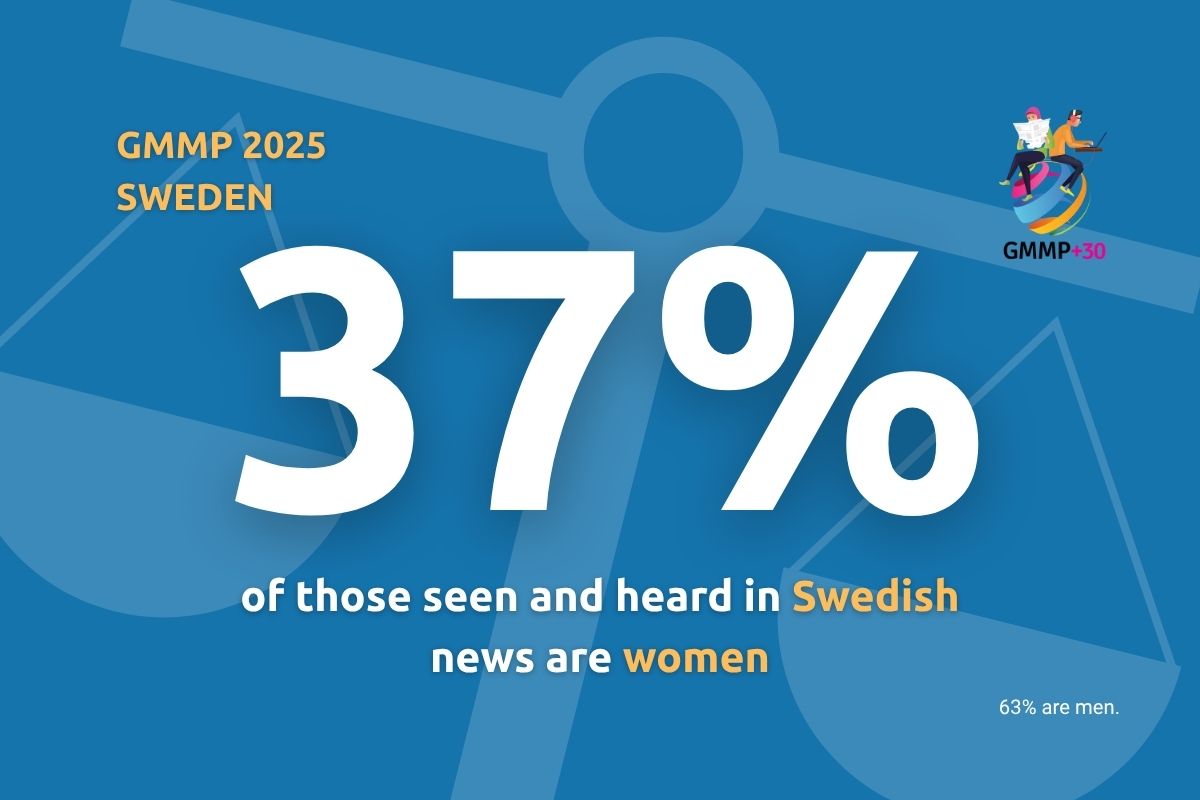
Despite decades of discussion regarding representation, the latest Global Media Monitoring Project (GMMP) study shows that women account for only 37% of people seen and heard in Swedish news. This represents a slight decrease from 38% in 2020. At Fojo, we view this as a clear signal that we must move beyond well-intentioned visions and towards practical implementation. When half the population is denied an equal place in the public conversation, journalism risks losing both relevance and public trust.
“News valuation still prioritises traditional power positions, where men are more frequently chosen as the spokesperson” explains Agneta Söderberg Jacobson, senior advisor at Fojo. “We observe that the role of the expert is more often assigned to men, which recreates old norms. However, there are positive signs, particularly where editorial offices work systematically.”
The power of consistent monitoring
The report highlights that the newsrooms reaching the highest levels of equality are those that measure their output daily. SVT Nyheter Västerbotten, for instance, has been tracking gender distribution for over 20 years. Today, they consistently achieve a 50/50 balance. This success is not the result of a single campaign, but of a long-term cultural shift where representation is discussed at every morning meeting.
Modern technology is making this task easier. Stampen Media now uses machine learning to automatically track gender in their published texts. Similarly, Aftonbladet uses real-time tools to monitor who appears in images on their homepages. This immediate data allows editors to make instant corrections, ensuring that the digital storefront of the news reflects a diverse range of voices throughout the day.
Breaking the “expert” glass ceiling
One of the most persistent findings in Counting Women 2025 is the disparity in roles. While women are often interviewed as “ordinary people” or based on personal experiences, men still dominate the roles of “experts” and “spokespeople.” This is particularly evident in fields like economics, politics and crime.
“To change this, we must consciously expand our list of experts,” says Agneta Söderberg Jacobson. “It isn’t about that female experts don’t exist; it’s about how our traditional routines lead us back to the same male sources.”
The report also addresses a darker reason why women might be less visible: the prevalence of online threats and harassment. Many women in the public eye are more hesitant to participate in interviews because of the backlash they face. For newsrooms, improving gender equality in media means not just finding female voices, but also taking responsibility for their safety and offering support when they are targeted.
A business case for diversity
Beyond the ethical and democratic arguments, there is a clear professional incentive. Media houses like Nerikes Allehanda have identified that a more gender-balanced output is essential for attracting younger, digital-first subscribers. To remain relevant in a changing world, journalism must look like the world it reports on.
As we look toward the future, the message of the 2025 report is clear: progress is not automatic. It requires intentionality, the right digital tools, and a commitment to seeing representation as a core metric of journalistic excellence.